CMOs get no respect. They have a lot of expectations placed on them—sometimes even quota—but marketers have no credibility with CEOs (“73% of CEOs say marketers lack credibility”, Lara O’Reilly, Marketing Week, June 2011), and marketing doesn’t have the board’s ear either (“Why CEOs Can’t Blame Marketing or Sales for Lack of Alignment”, Christine Crandell, Forbes, February 2011).

Both articles claim different reasons for the lack of respect. Lara O’Reilly cites a study by Fournaise that makes very good points why the CMO is at fault, and Christine Crandell opines eloquently why the CEO is to blame for the lack of respect the CMO gets.

The general complaint is that marketers cannot prove with certainty how much impact their efforts have on the top-line of the business (my opinion: because marketing is a process that takes time, and it’s difficult to measure any network effect with precision).

Jerome Fontaine, CEO and chief tracker of Fournaise, says that “. . . marketers [need to] start speaking the P&L language of their CEOs. . .” CEOs want CMOs to have a greater grasp of the business, not just the pretty side of relationship building. CEOs want to know about “revenue, sales, EBIT and market valuation.”

Market-Based Management: Strategies for Growing Customer Value and Profitability (Pearson Prentice Hall, Fifth Edition, 2009)—a fantastic book for anyone who needs to grasp the basic concept that marketing is a lot more than promotion and advertising—offers a simple formula to show what incremental revenues marketing produces:
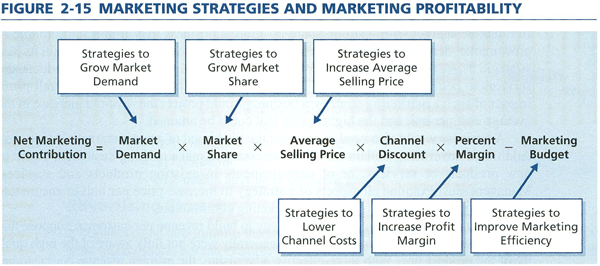
Net Marketing Contribution, Roger-Best, Pearson Prentice Hall

Net Marketing Contribution, Roger-Best, ©2009 Pearson Prentice Hall

McKinsey even published a whole article on “Measuring marketing’s worth” (see previous post). The article tries to teach the CEO how to appreciate the CMO. Instead, in my opinion, the article is actually an excellent blueprint to help aspiring CMOs prepare for their larger role. Still, ROI does little to convince the CEO that the CMO is moving the needle in an appreciable fashion.

The more serious problem appears to be that the two sides do not understand one another. The CEO doesn’t understand marketing beyond promotion and advertising. The CMO doesn’t understand accounting and finance. Two ships passing in the night.

Let’s have a brief look at both positions.

CEOs are captains of the ship. They must have an understanding of every core discipline in the company, even if they themselves cannot be expert at everything. That’s why they hire very smart people to do the things they themselves don’t have the time or knowhow to do well consistently. CEOs are also the face of the company, and in some ways must embody the brand. They must be super-smart brand ambassadors in both B2B and B2C settings.

The CEO is responsible for:

  • Corporate performance—profitability and valuation.
  • Corporate strategy—assuring that the company remains a successful going concern.
  • Capitalization—so that the company can reinvest in growth and innovation.
  • Corporate culture—creating the desired climate and leading by example.
  • The C-Suite—recruiting the best executive talent so that the company outperforms.
  • Executive performance—understanding the correct performance metrics (Christine Crandell’s point).

CMOs are brand-builders who craft unique and powerful value propositions. If all they think themselves responsible for is lead generation, then they are only advertisers. CMOs must want to influence innovation (through voice of the customer and competitive positioning), and lead sales, marketing, and customer care. You read correctly; I believe the marketing department must own the customer (customer lifecycle management). Sales, promotion, advertising, and customer care are all functions of marketing; marketing being the discipline of bringing a product into the market successfully. And a sale is not successful unless the customer is happy long-term.

The CMO is responsible for:

  • Competitive strategy—being one step ahead of direct competitors, new entrants, and substitutes.
  • Branding/positioning—placing irresistible core values in the buyer’s mind.
  • The customer—lifetime customer satisfaction and perceived value.
  • Pricing—for the greatest lifetime profit and customer retention (not volume-based).
  • Corporate image—the public perception of the company.
  • Lead generation—meaningful and authentic message dissemination that moves markets.

So apparently there is little overlap between the CEO’s and CMO’s responsibilities. Crazy, since they are co-pilots for success.

Back to the Fournaise study. Revenues, sales, and EBIT are accounting principles. Valuation is a finance principle.

Basic accounting principles are easily learned. I bet there’s a good Dummies-book out there. Now it finally dawns on us: we marketers are hated by everyone in the company who values a balance sheet. Marketing, the entire department—overhead and all marketing activities—is an expense. No wonder there is such a myopic focus on ROI and lead generation. CMOs must perform by the fiscal year calendar, which pretty much kills any long-term strategic and tactical initiatives around building a brand.

The only time marketing expenses are “good” is when they create a total corporate loss that the company can then write off in subsequent periods. That in itself is an untenable situation.

Accountants lord over the marketing department, however subtly.

To win real respect, CMO’s must increase the value of the company beyond the sum of its future earnings. Good ones do, but few of them know how to prove it. And that’s the real rub: CEOs and accountants want CMOs to prove something that they’re not permitted to prove by accounting standards.

Goodwill—what I call the toilet bowl of the balance sheet, because it’s essentially a bunch of hooey—does not permit for the accounting of internally created value (read: brands). Only acquired brands can be accounted for on the balance sheet under goodwill. That math is actually very simple: brand value is the difference between the book value of a company, and what it was actually acquired for. And that’s the needle (read: multiple) that the CMO has to move.

Which needle? The valuation needle.

So, don’t get another MBA, this time in finance. Learn about valuation via an adult-ed course at your local community college or take an online course. Even a simple search for “company valuation” on Investopedia brings up great results.

These are not tricky concepts, but they do take time to acquire as skills. The best thing you can do is practice for a little while, and then begin to build a valuation model for your company that you test over time, and that shows how you are moving the needle (or could be moving the needle given permission).

Give it some months, then you spring it on your boss and. . .*BAM*:

  • Instant credibility with the CEO and the board.
  • Bigger budget!
  • Permission for long-term strategic planning and tactical execution.
  • Increased self-worth (and probably pay if you negotiate well at the close of the fiscal year).

And now for the real conclusion: career advancement is not the real benefit here.

There are many different valuation models, and valuation, for the most part, is a bunch of hooey, too. It’s like selling your home, which is worth only what someone else is willing to pay for it, not what you think it is worth. The book value of your home is the worth of the land and the dwelling on it—at cost. That’s what you pay taxes on. But you know that there’s additional value in the place. And that value is determined by many factors: listing price of comparable dwellings, ranking of school district, quality of home construction, proximity to emergency services, etc. These and other factors give your home value beyond book.

The better prepared you are for your buyer—the better you can support your arguments in your valuation model—the more likely you can affect a positive outcome for yourself. That’s because valuation teaches you to examine where and how marketing adds value to the company. And when you understand that, you also market better.

And that’s how you build a brand, by listening to the market and understanding how to respond. Your model will tell you what to pay attention to. What are brands? They are needle-movers; they get chosen more frequently, even at higher prices. You can be a needle-mover, too.

[And thus finance quietly trumps accounting. But don’t tell the accountants.]
A decade ago (and before) there was a publication called “Business 2.0.” It wasn’t a bad magazine, but its demise was a certainty when the dot-com bubble burst.

The magazine’s name came from the evolution of the Web. Web 1.0 meant having a website. Web 2.0 meant having an SLA. And because the Web and uptime would revolutionize everything, Business 2.0 meant that nothing we learned from business in the past mattered anymore.

Today we are still using the phrase Web 2.0, and on occasion even business 2.0 (now lower case), but we’ve learned that the past is still relevant. In the interim the meaning of Web 2.0 shifted from SLA to ROI. ROI means generating a quick recoupment for the cost of acquiring a solution. But this rarely means TCO (total cost of ownership), because there usually is no real measure for whether the 2.0 solution truly helped the company, either by making it more efficient of profitable.

So what is business 3.0? It’s not a magazine. It’s brand trench warfare driven by Web 3.0.

Web 3.0 is about being a digital front-end, a portable brand experience. It’s about giving people the ability to interact with mundane and exciting things in their lives whenever and wherever they want. It isn’t about mobile, and it isn’t about social media.

It is about letting the end-user make choices and decisions in real-time. PI (personal intelligence) instead of BI, driven by your brand.

Is txt-banking exciting? How about taking photos of physical checks? NOT EXCITING. But very useful. How about finding your car? Shopping for shoes while riding the bus?  Attending lectures on your mobile phone? Crowd-sourcing? Competitive intelligence? Pattern recognition? Location-based services? Near field communication? Help in medical emergencies? All tailored to the individual.

What is the lesson for marketers?

Web/business 2.0 was about opening individual doors to sell individual solutions—a crowbar approach; effective but crude. Web/Business 3.0 is about creating seismic events in the marketplace, extending the length of the crowbar to unhinge the competition or an entire market.

That’s what your brand has to do. It’s not just about utility. It’s about crushing the competition.

Branding 3.0: position with care and also extreme prejudice! Let the buyer know that you solve a problem so completely that no other solution needs consideration.

As always, communicate benefits, not features.

The secret to successful marketing is that you need to bring the horse to water, but the horse must believe it found the water itself.

You do that by enlarging the pond. Unbeknownst to the horse, the next time it looks around it sees the solution to its problem and consumes it.

What that really means is that you must understand your customer. And since you likely have more than one customer profile (marketing speak: segmentation), you’ll need to address your multiple customer-types based on their preferences.

How many ponds do you have? And how are you filling them?

Make sure that your brand is not a hedging instrument, but a competitive differentiator.

Lots of people have business ideas. Some of them actually turn these ideas into viable companies. They don’t have to be large companies to be successful; just profitable.

Many people, including established business leaders, follow this approach to product and brand development:

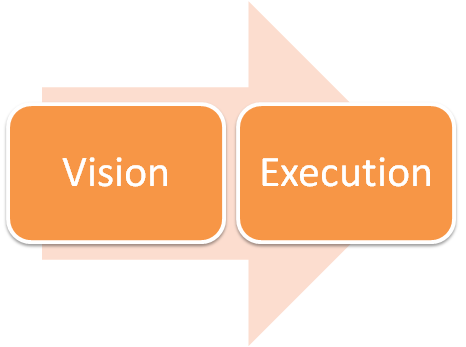
Vision - Execution

Rapid prototyping is certainly one way to find out if your idea will be successful. It also follows a very common entrepreneurial mantra: fail fast. This is certainly the right approach if you are not betting much, and therefore have little to lose.

If you are risking a little more—say, your mortgage, or the future of your company—a more thoughtful approach is this:

Vision - Strategy - Tactics - Execution

Now thought and analysis come before your putting a PayPal button on a mail-order lard sandwich website or the opening of garden gnome restoration store.

Vision is the idea phase. You’ve observed something that you can do better, or for which no solution exists as yet.

Strategy is the positioning phase. This is the hardest part, because you need to get this right: you define the core essence of your offering to which a self-selecting audience will respond. You don’t just decide to have a luxury or mass-market product, you envision your buyer and why he/she will be attracted to your design.

However, before moving to the tactics phase, you also do some real analysis. You analyze your fledgling company (SWOT analysis), your product (VRIO analysis), and the competitive landscape (Five Forces).

Once you’ve figured out your uniqueness and competitive white-space, you can move on to the next step.

Tactics are about process. How will you get your product made (within budget and on time)? How will you get it distributed, noticed, and sold?

Here you realize you cannot accomplish everything by yourself. You need to delegate to other experts. You are the expert in the why and what of your product/service. The others are experts in the things you don’t know or don’t have time to do well. Don’t just rely on smart people for this, rely on people who are smarter than you in their fields of expertise. Then let them do their jobs. But communicate all the time.

Now comes the other hard part.

Execution—marketing, sales and customer care—is about people. Your people; your corporate culture. This is what touches the customer, and what must communicate with one voice. Is the essence you have promised carried through all the way?

Here is where many make a classic mistake. You want to over-deliver. You want your customer to have the best experience ever. Instead, you need to deliver to the correct expectations; the expectations you have set in the positioning, marketing, and sales phases (which need to be the same throughout; one voice!).

Do not over-deliver on product reliability, features, customer service, etc. If you do, then you will have raised the expectations bar permanently. Obviously, if you’ve promised 24/7 world-class service, then you need to meet that expectation. But if you’ve promised 18/7 world-class service, but deliver a higher level, then you will disappoint if later you “fall back” to 18/7 world-class service.

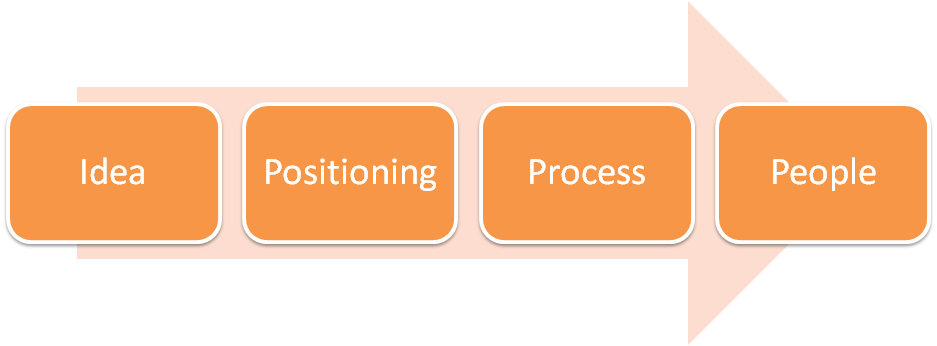
In other words, realistically (not academically or theoretically) you need to do this:

Idea - Positioning - Process - People

Here is what goes on in your customer’s mind. Let me narrate:

  • “I have a need/problem.”
  • “Is there a solution out there that I can trust?”
  • “Let me do some research with my trusted advisors and networks.”
  • “This product/service/solution is great/terrible/neutral.”

In other words:

There are no brand do-overs. Brand is the perception of how you positioned your offering and whether it was an experience congruent with the buyer’s expectations.

This is a linear path. Continuous improvement and cyclical refinement only happen in the last stage. That’s where you get to keep and defend your brand, and entertain brand extensions.

If your customer never permits you to get to the last stage, because you’ve not achieved positive brand status in the buyer’s mind, then you might as well advertise in the Yellow Pages, because you couldn’t differentiate yourself and will have been an also-ran.

So do this at every stage:

Listen - Listen - Listen - Listen

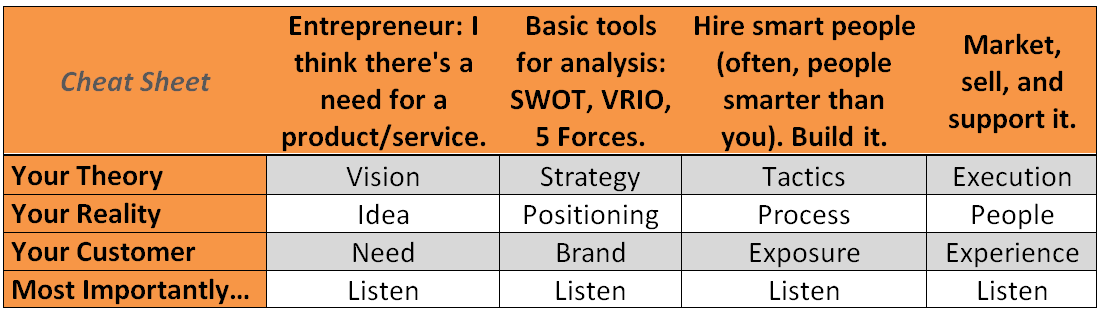
OK, here’s a brand strategy cheat sheet:

Brand Strategy Cheat Sheet

I find this post on Clients from Hell completely inspiring:

I got this email once from some lawyer in Nigeria and when I opened it and clicked the link, the same email was sent it to everyone in my contact list. I thought, hey, this is a pretty smart and simple marketing technique.

When I send out this email to the 4,000 people, I want it to automatically forward to everyone in their contact list.

Can you have this done for me by tomorrow?

Don’t do this. But he’s got the right idea!

Explosive growth is a good problem to have. You are on your way to becoming/having a brand.

Explosive growth that you cannot satisfy is a bad problem to have. You are on your way to ruining the brand you could have had.

Fortune favors the prepared.

Christine Crandell in her seminal work “Buyer 3.0 and the Buyer’s Journey” takes us through today’s research and evaluation process B2B buyers engage in before even reaching out to a vendor for information.

The very basic lesson is that you (the vendor) need to be visible and findable in the arenas and trusted networks where buyers start their research, and Christine gives very good guidance for how to be visible, and what needs to be visible.

Additionally, she has identified six characteristics of Buyer 3.0 that today’s marketers need to be acutely aware of:

  • Views the buying experience as a precursor of the customer experience.
  • Outcome-driven and expects to receive meaningful value at every step.
  • Thoroughly researches potential purchases and alternatives long before contacting sellers.
  • Considers any inconsistencies in the buying “experience” as a warning sign that future expectations will not be met.
  • Uses multiple social channels to interact with and expects sellers to be able to follow the conversation across channels.
  • Proactively shares product and seller experiences with his/her social graph.

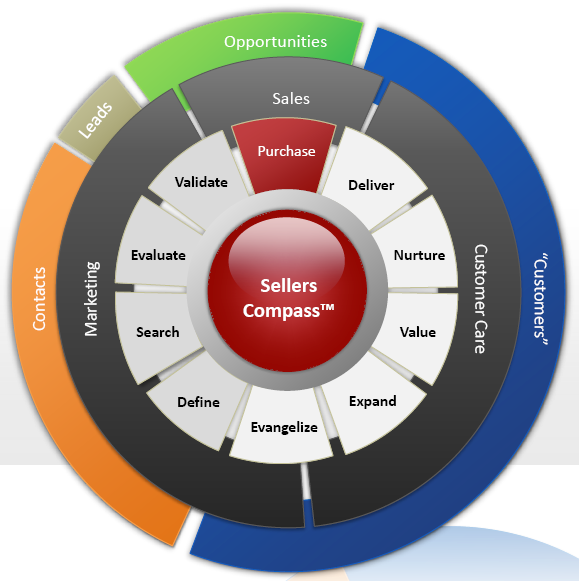
The research phase pointed out above in bullet three is captured in her Seller’s Compass™, and she makes the point that 70% of research that leads to a buying cycle is performed before the buyer even reaches out to the vendor. You don’t stand much of a chance if you don’t get this right.

Copyright 2012, Christine Crandell

However, I think the Seller’s Compass™ isn’t just guidance for marketers; it is a blueprint for every step in customer life-cycle planning and management that must be exercised by every department that ever touches the customer.

Instead, I call the Seller’s Compass™ the Brand Wheel. The buyer’s journey—the expectations and experiences—goes beyond brand planning, straight to the heart of corporate culture. A brand can only thrive if it is supported and championed by the right corporate culture. Marketing, Sales, and Customer Care must act and communicate in unison to continuously deliver the expected (promised!) brand experience.

And while I hold corporate culture responsible for this, strategic and executive leadership is responsible for corporate culture. Now all they have to do is pin this on their wall and get a clue (How? The Services Gap Model; future post.)

The best value proposition is to solve a complex problem simply.

The issue is that this doesn’t create any real barriers to entry for competitors since they could easily copy the solution (can you afford a full-fledged patent dispute not knowing if victory will be assured?).

Complex solutions are easy to sell…because they are complex. The complexity implies value, and people are willing to pay a lot for that—they’re not willing to pay much for simple solutions [that deliver the same value]. Paying for the process seems much more important than paying for the result.

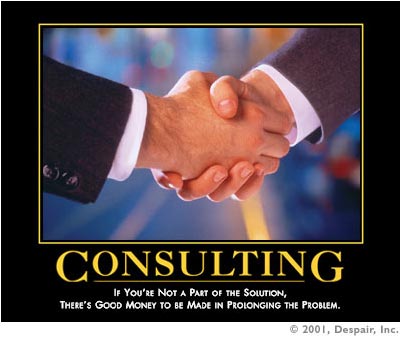
We all know the adage about consultants: if you can’t be part of the solution, be part of the problem and continue to get paid.

Imagine then a consultancy that doesn’t sell fish, but instead teaches its customers how to fish.

Kepner-Tregoe (KT) has a product called “Problem Solving & Decision Making” (PSDM) that teaches companies how to problem-solve. Such a shame then that KT’s best PSDM marketing asset—a customer video testimonial—is buried deep within the site.

You’ll never find the video—the site is a bit of a marketing (UI/UX) disaster. So here are two links to the video. Enjoy.

It’s a very powerful message, and a very simple (but not simplistic) solution. I wonder how well it is selling. And I wonder if they get repeat business from turning customers into thinkers and independent problem-solvers.

The only way to create a brand is to deliver to expectations that were set correctly in the first place.