The other day an email came in from my friend Steve in NYC, who writes the Smoky Beast (weekly whisky reviews) blog with his wife, saying “we published our first interview with a bona fide master distiller.” Aside from reading the post, and additional whisky reviews, I thought to myself that I, too, know great people who are passionate about the same topic I am. And since I am a marketer I was obligated to steal Steve’s great idea.

I first became aware of Jerry Rackley on a Demand Metric webinar, where he was simply incredibly insightful (he’ll introduce himself below). After the webinar I reached out to Jerry, and to my joy, he responded. I’ve been following Jerry’s insights ever since, and was ecstatic when he recently referenced a blog post of mine on Demand Metric’s Analyst Perspectives Blog: Creationism Versus Evolution: A Branding Debate.

It was a no-brainer that I would reach out to Jerry Rackley to interview him on marketing. The following is a distillation of eight pages of our transcribed telephone conversation. A lot was left on the cutting room floor, but these nuggets of wisdom will inspire any marketer.

Who is Jerry Rackley?

I am the chief analyst for Demand Metric, which is a marketing advisory firm. In addition to that, in my free time, I get to be an adjunct faculty member in the marketing department at Oklahoma State University. I enjoy being in the classroom and working with students, and also really love being chief analyst and working with our members and clients on their marketing issues.

What do your marketing students need to understand today?

Some of the most interesting, rewarding marketing work is going on in small, hungry, lean companies where you don’t have the safety net of a large budget bank account to just run lots of experiments and try different things. Now you really have to figure out how to communicate, how to position, how to contribute and provide a return. If you don’t, the company can’t afford to have you. To me, that’s what I really try to make sure that my students understand.

How do you know your customer?

That’s the $64,000 question. Any effort of marketing, whether it’s content marketing or just any marketing, that doesn’t begin by asking, “Who is our audience?” or, “Who is this content for?” is destined to fail.

The problem is we marketers have all kinds of assumptions built in about our audience that we just don’t bother to back and check. Or we just think that we’re so smart that we don’t have to ask, we already know, because we’ve been doing this for a long time. We get in our own way. That makes it hard culturally to really do the things we should do to understand our audience.

The second thing that happens is that customers don’t reveal themselves as readily as they once did. If you look at any buying process, especially in the B2B world, the customers choose to remain hidden and self-educate much deeper in the buying process than they used to. They can do that because look at what marketers are doing: we’re putting all kinds of great content out there for potential customers to consume.

For those reasons, it takes a lot more effort to understand who our customers are, understand their preferences for communication, what sources of information do they trust, what biases they have. A lot of companies simply just choose not to take advantage of that knowledge either because they think they can’t or because they think it’s too difficult.

On content marketing.

A lot of companies buy into the notion of “we’ve got to be content marketers.” Great, do it. Then they just randomly start emitting content and they don’t necessarily think about what content is needed in each stage of the buying process. (1) What is needed in the need-phase when someone is just figuring out they need something? (2) What’s needed in the discovery-phase when they are actively out there looking for a solution?  And (3) what’s needed in the consideration-phase when they are trying to separate the wheat from the chaff?

Companies need to pay attention to the different kinds of content that customers are looking for in each phase.

In the Need-phase, third party content is always valued, so much more in this stage of the sales cycle. Peer input, analyst research and reviews are very much sought after. While marketers can’t directory author this type of content, they can create mechanisms and processes to facilitate its creation and capture. In terms of vendor content for this stage, things like eBooks, White Papers and educational webinars work well.

During Discovery the kind of content valued in this stage is still very light on promotional messaging, but heavy on being helpful! How-to guides and case studies are two examples of what works well. Both of these content types are very effective in video format.

Lastly, the Consideration-phase marks the point where the buyer stops expanding the list of possible solution vendors, and in fact begins narrowing the list. Content that is very helpful in this stage is anything that conveys critical success factors, user success (or horror) stories, content that effectively articulates differentiation as well as description and quantification of benefits.

Are there differences still between B2B and B2C marketing?

A lot of the principles of marketing apply across both, but B2C is still is about brand strength and awareness. B2B has a much stronger relationship component.

B2C players have very little chance of actually knowing their customers. When I say knowing them, I mean an actual real relationship and interaction like you and I are talking now. You know my name and I know your name and I know where you live and work and that kind of thing. That’s pretty unheard for the big B2C players. Yes, they’re going to know their customers demographically, but the bigger they are the less likely it is they’re going to have a real relationship. There are simply too many players between them and the consumer in the supply chain.

B2B on the other hand is an environment in which most of the time you actually know do your customer. You can have a face-to-face interaction, you have a relationship. While brand is still important—and brand is always going to be important—relationship strength can really overcome some brand weaknesses in the B2B realm.

That’s what a lot of B2B companies have figured out: we’re going to go establish relationships. We’re going to know customer needs better than anyone. We may not have the market-leading solution for each one of those needs, but we’re going to use all the influence we have through the relationship to secure business and serve the customer well. Many times, it does work very well as a strategy.

What excites you in marketing?

I think the thing that continues to excite me is when I see real genuine authentic creativity and pure marketing genius. We as consumers are subject to such a barrage of marketing messages, we kind of are numb. We see so many different messages in so many different forms from so many different places that we just kind of tune a lot of them out. When one actually gets through, when we allow one to penetrate our consciousness, that’s a pretty remarkable thing. I think that as marketers we all sit up and take notes. How did they do that? I think usually it’s because it was very clever, or in some cases their cleverness was exploiting an opportunity that was handed to them.

An example is the Super Bowl, the famous Oreo tweet that occurred during the Super Bowl. That was genius, but when you study it, it didn’t happen accidentally. I really admire the way that occurred. Oreo had a creative team on, I would call it, hot standby. These folks were sitting somewhere in kind of a war room during the Super Bowl. Of course, they were thinking social media, but they were ready and they understood there is a potential opportunity on a really big stage for us to do something. When they had the blackout, they put out that now famous tweet. It just skyrocketed in terms of the retweets. It was a huge success from a social media standpoint. I have no idea what it did to their revenues or their market share or anything else. It was brilliant, and they positioned themselves to do that.

Those kinds of things excite me. When I see someone who takes creative risks, and it’s very creative, I respect the fact that they’re not trying to serve up the same old thing that we’re used to seeing all the time.

When I was living on the East Coast, traveling to the West Coast posed no problems for productivity and alertness. Flying across country one would lose very little time, and due to the three-hour time difference, getting up early in the morning was also a cinch.

Now I live on West Coast time. AZ doesn’t play that Daylight Saving Time game, meaning, that for most of the year (March 10th to November 3rd; or as I call it, Conference Season) our time is actually equivalent to PDT, because we are always on MST, while the rest of you waffle back and forth.

Traveling to the East Coast is a chore. Often meetings and conferences start at 7:00 AM—especially when you are an exhibitor—meaning you have to get up at 6:00 AM, which is 3:00 AM your body clock.

That means, in order to get a good night’s sleep one also needs to go to bed [relatively] early. Going to bed between 9:00 to 10:00 PM East Coast time means my body thinks I’m trying to go to sleep between 6:00 to 7:00 PM per my body clock. That takes some coaxing.

I’ve never take prescription sleep aids, but do purchase “non-habit forming” OTC pills to help me get to sleep on those trips. So when my wife handed me a $3-off coupon for ZzzQuil (from the makers of NyQuil!) I thought I could save some money. I stopped taking NyQuil when they took out the sleepy stuff, and was excited to see I could get the sleepy stuff again from a brand that has previously served me well.

Here I was at the store holding a 24-count box of ZzzQuil (suggested retail price of $11.99) when I decided to look at the active ingredient: Diphenhydramine HCL. That sounded familiar… So I acted on a hunch, turned around and grabbed a box of Benadryl to look at it’s active ingredient: Diphenhydramine HCL. And at the exact same dosage: 25mg. Except that a 48-count box of Benadryl has a suggested retail price of $8.99.

It’s not difficult to figure out which the better deal is.

The question, however, is which is the stronger brand? Benadryl is definitely a strong brand name. It comes to mind immediately (unaided recall) when considering an allergy remedy, and the ingredient Diphenhydramine HCL is often simply referred to as Benadryl.

But why would Vicks be able to command a better than 150% price premium, when brand differentiation typically tops out at a 25-30% price premium for like products? Does it really have that much better brand recognition than Benadryl?

The answer to the question probably isn’t brand, but positioning. Without any empirical research I simply have to assume that Vicks plays in a market that solves short-term problems (e.g. flu symptoms) to which immediate solutions are needed, vs Benadryl, which handles long[er]-term problems (e.g., seasonal allergies) that also require a longer-term investment. I’ll pay just about anything to get over this cold quickly, but since there is no way to control the weather, seasons, and pollen, I’ll pay as little as necessary to remedy problems that will recur not matter what.

Additionally, I can tell you that OTC sleep aids are not cheap, so Vicks should be able to easily maintain pricing power with this brand extension. It’ll be worth watching how Vicks fares in that arena over time, and if enough people might catch on to the cheaper alternative. Benadryl (McNEIL-PPC, Inc., actually) might not be able to do anything—can’t openly compete against ZzzQuil—because they can’t jeopardize the positioning they’ve created for themselves.

Vicks’ only problem might be that if consumers learn of this and feel taken advantage they might vote with their wallets and pocketbooks against Vicks’ other brands as well.

At play is a possibly risky pricing strategy that has a chance to blow up and do larger damage than just cutting into ZzzQuil’s profit margin. On the other hand, Vicks might just be raking it in until then, and they might never get found out. And if Vicks does need to drop ZzzQuil’s price, that just might set off a price war in OTC sleep aids. Hallelujah.

Let’s get ready to rumble.

Lesson to marketers: know the risks you are taking and plan for the various scenarios.

Tim Cook is receiving a lot of press for asking the board to alter his compensation plan to better match performance (or lack thereof): see here (CNBC), here (CNN), and here (Mercury News).

In “The Fascinating Part of the Changes to Tim Cook’s Restricted Apple Stock”—so far the only journalistic piece I’ve seen that doesn’t just shovel boilerplate—Tim Worstall digs deeper. First he discusses how this model might infuriate fellow CEOs whose only real desire is to have their hand in the corporate till (my words), and how this move by Tim Cook and Apple’s board exhibits real leadership on executive compensation.

Second, he also exposes that Tim Cook isn’t actually exposing himself to too much financial peril, which is the true point of that article, and makes it a fascinating read.

I think that instead of leadership and altruism, a different motivating factor is at work: self-preservation.

Tim Cook knows he’s not Steve Jobs, that he cannot make evolutionary products seem revolutionary, which causes irrational exuberance. That doesn’t mean that at its peak the stock price was inflated. A stock price reflects the total expected future earnings of a company, and with the hype stirred up by Steve Jobs that surrounded Apple’s products and services, those earnings would have seemed likely/possible. But the sheen has worn off.

That doesn’t mean that Apple’s products aren’t any good—they are very good—but they are once more being evaluated on their merits, and there simply is a lot of competition out there.

Given Apple’s precipitous stock decline, and North American boards’ and shareholders’ unwillingness to have a long-term view, Tim Cook would normally have been fired by now. He’s certainly not gaining friends in the investment community (stock price of $1,000, anyone?).

Tim Cook can now be the CEO for the next ten years, not outperform the market but keep his job, and still out-earn all of us in one year what we cannot even earn in a lifetime. Per his comp plan, even if Apple is in the bottom-third of S&P 500 performance, he will still be granted 50% of his RSUs. That means, written into his contract now is that he can be a shitty performer, yet still receive 50% of his bonus compensation. It also means the board cannot really fire him for under-performance since it has agreed to these terms. Very shrewd bargaining indeed.

Tim Cook possibly faced getting fired soon, so instead he bought himself time (literally) and a ten-year revenue stream in the process. Tim Cook is probably a good shepherd, but not necessarily a great leader. He is, however, very wise: he knows when he has enough, and that more isn’t necessarily better. And he certainly knew how to package and sell that. If only he could do that for Apple, not just himself.

What’s really broken in executive compensation is tying it exclusively to shareholder needs, instead of the broader stakeholder needs (triple bottom-line stuff). Stakeholders include employees, customers, suppliers, the environment, etc. With a ten-year CEO runway Tim Cook can now ignore quarterly results. That’s actually very good, because he can focus on the real needs of the company. But he could also have put a real leadership stake in the ground by incorporating the larger universe of needs in his bonus plan, instead of just focusing on his own.

[Lest we forget the point of this blog…lesson to marketers: don’t hoodwink your audience.]

The June 2013 issue of the Harvard Business Review contained a gem so powerful that it could rewrite creative advertising strategy overnight. “Creativity in Advertising: When It Works and When It Doesn’t,” is a summary article of a study that reviewed 437 TV advertising campaigns for 90 FMCGs over a span of five years.

The study found that creative ads not only perform better, but also actually do drive incremental revenue. You might think “Duh!” and also mimic a face-palm, but there are two very important findings here. First, rather than correlation, there’s now documented causation. Second, it’s the type of creativity that matters. Not all creativity is equally rewarded, some can actually hurt you, and its application is even product-specific.

Creativity is made up of five dimensions: Originality, Flexibility, Elaboration, Synthesis, and Artistic Value, and the most powerful combination of creativity is Originality + Elaboration. The article explains each dimension very well, which is why spending $6.95 on the PDF (if you are not already an HBR subscriber), is will be the best investment you have made as a marketer this millennium so far.

However, there is one giant caveat, which the authors are completely up-front about, but never delve in to: all the ads ran in Germany. What does that mean to you?

Stories abound about how ill-named products didn’t sell well when introduce into other countries, and it is now well known and documented that you can’t just move a product and advertising campaign from one country to another, from one culture to another.

A simple example is a life insurance TV campaign that ran in South America. The scene is set at night, and the camera is pointed at a bouncing car with fogged-up windows. Emanating from the car are certain sounds made by a woman that suggest that at present a very personal and private interaction is occurring; one that is known to occasionally occur in cars, but more often in bedrooms. As the camera ultimately reveals, the woman is performing CPR on her partner, which is a physically demanding act that would cause windows to fog up and the car to bounce suggestively.

The ad was successful in Brazil, because it is culturally relevant and appropriate. The ad agency (McCann-Erickson) than ran the same ad in Chile, where it cause outrage. What went wrong? Both countries are relatively close to one another, geographically speaking on a global scale, so shouldn’t they be similar enough culturally? Chile, it turns out, is a culturally very different from Brazil; it is politically, economically, and sexually a very conservative country. It didn’t matter that both nations are located in South America and had strong economic ties. What did matter is that they were cultural opposites.

So, how do you know that an ad successful in Germany would also be successful in the U.S.? More specifically, how do you know that the creative dimensions relevant to German culture map well to U.S. culture? How do you map culture to culture?

Luckily, there are culture assessment and mapping tools out there. The obvious one is the Cultural Orientation Indicator (COI PDF), developed by TMC, a subsidiary of Berlitz (the language people). It is actually a personal assessment tool. The COI focuses on the self and measures ten cultural dimensions, but I’ve used it to map countries’ cultures against one another. You’ll need to pay to gain access.

Here’s some example output:

Cultural Orientation Index COI

Cultural Orientation Indicator Sample Output

Another good tool—this one is free (!)—was developed by Dutch professor and researcher Geert Hofstede, and is available via the Hofstede Centre’s website. Here you can assess and compare cultures on six dimensions (quite different from the COI).

Hofstede-USA-GER

Neither tool lets you query for similar cultures, but you can select individual countries and compare them to one another. Also, neither tool will tell you outright if the five creative dimensions correlate across cultures, but it’s a better approach to leveraging HBR’s insights into creativity than simply trying to replicate your advertising creative across different cultures and hoping for the same results. At least you are now empowered to better assess whether creative dimensions that play well in Germany are also likely to translate well into other countries and cultures for which you have advertising responsibility.

The true power of HBR’s research will be revealed over time as people match cultures against the five creative dimensions. That is the Holy Grail.

If you want to learn how to do this well, and how to develop your Cultural Intelligence (CQ), your best bet is to reach out to the Najafi Global Mindset Institute at the Thunderbird School of Global Management and find out where you rank in the Global Mindset Inventory (YouTube), so that you can learn how to best exploit these cultural mapping tools.

Last week I attended BtoB Magazine’s “The Evolving B2B Purchase Process: Conquering Unpredictability with Full-Funnel Marketing” webinar. Very interesting research findings were presented, and the Q&A was excellent.

The last question in the Q&A drove me crazy, however: Where and how do we begin our marketing efforts for “…a relatively new brand with no awareness?”

It wasn’t the content of the question that bothered me—and the answer was very good—it’s the context that gave me palpitations, and almost caused me to scream “YOU DON’T HAVE A BRAND!” into my headset. Of course, in cyberspace no one can hear you scream, especially when you are on mute.

I hold in strong belief—and have previously stated here—that brands are not “made” nor “owned” by companies, but by consumers. Companies may own trademarks, but branding is a consumer’s mental process. Companies try to influence this process, yet ultimately they have no true control over it. Correlation of a consumer action to a marketer’s efforts does not equal its causation.

I’ve never been able to prove my belief. Finally, however, I happened upon a model that echoes my own conviction: McCracken’s Meaning Transfer Model.

In “Who is the Celebrity Endorser? Cultural Foundations of the Endorsement Process” (Journal of Consumer Research, Vol. 16, No. 3 (Dec., 1989), pp. 310-321; available on JSTOR), McCracken stipulates that “there is a conventional path for the movement of cultural meaning in consumer societies.”

While the article speaks to celebrity endorsements—how a personality imbues its persona onto a product—the model’s underpinnings rest on “cultural foundations” (read: psychology) shared by all of us (in the West).

There are three steps in the model. First, to pick the right celebrity “the advertiser identifies the cultural meanings intended for the product.” This speaks to product positioning—not tactically (conventional benefits) or strategically (competitive benefits), but psychologically. Think BMW’s “Ultimate Driving Machine,” versus Volvo’s safety and security positioning. Both are cars that will get you to where you want to go, but their positioning appeals to different audiences. This is where companies place their marketing chips for decades.

Next, “the advertiser surveys the culturally constituted world for the objects, persons, and contexts that already contain and give voice to these mednings.” The producer/advertiser seeks an individual/celebrity possessing elements congruent with the psychological profile they are trying to assign to their product. The advertiser similarly hopes that aspiration to these traits is resident within the target buyer. For example, Sebastian Vettel might be a good celebrity endorser for the Ultimate Driving Machine. For our purpose the object does not have to be a celebrity, but can be anything else that already carries the intended strong metaphorical meaning. Granite, for example, can represent the foundational financial strength that a bank wishes to emphasize.

Third, “the final act of meaning transfer is performed by the consumer, who must glimpse in a moment of recognition an essential similarity between the elements and the product in the ad…Consumers turn to their goods not only as bundles of utility with which to serve functions and satisfy needs, but also as bundles of meaning with which to fashion who they are and the world in which they live (Belk 1988).”

Just in case you didn’t catch that, while the meaning transfer steps are linear and sequential, 1-2-3, the meaning transfer motion is not. Meaning is not transferred from the producer into the product, and then from the product to the consumer. Consumers transfer their own meaning onto the product! The consumer has to be accepting and complicit in permitting the producer’s hoped for meaning—but the consumer may very simply attach an entirely unintended meaning, away from the producer’s intent. This is why consumer insights departments are so critical.

When consumers attach the same meaning repeatedly, and that action constitutes a preference over a product with similar tactical benefits, then brand-creation is in process, but not yet complete. A product is only a brand when it is chosen often enough, with high repetition, by a large number of people within the addressable target audience. Otherwise a product is just a commodity, regardless of price or positioning.

A good example of consumer brand ownership is Tropicana Orange Juice’s “rebranding” a few years back. A simple packaging change—the actual product inside the package had not changed—destroyed the meaning that consumers had themselves attached to the product. The updated look of the juice container was described as generic, and generic juice at a premium price was incongruent with consumers’ psychological needs. Ultimately, Tropicana was forced to retreat.

Most importantly, it means that companies must continuously research and learn why consumers are choosing their products, and then for the same product target the correctly personalized message at the right audience, in the right channel. Mixed messaging sends mixed signals that cause confusion and lead to brand erosion.

It also means that companies are not brand owners, they are brand stewards.

The other day, watching a program on human origins and evolution, I learned or the term persistence hunting. It’s a technique we humans devised to hunt and kill fast [meaty] prey. The gist of it is to pursue a target for so long until it too exhausted (e.g., heat shock) to escape any further, making for an easy kill.

There’s an analogous tactic in digital marketing called “retargeting.” Retargeting is dead simple. Potential buyers visit a vendor’s website, get cookied, and then get served ads for the vendor’s offering on other sites. In essence, marketers get to pursue potential customers to the point of exhaustion, until they’re finally ready to buy (get killed)—or so the thinking goes.

However, retargeting is missing a major point—it needs to be contextually relevant. Presently I’m getting pursued by Zvox, Watchismo, Hilton, and Medifast. Everywhere I go on the Web I’m being bombarded by ads for these companies’ products and services. But the ads themselves are not relevant to what I’m actually interested in at the moment. And that’s creepy.

While talking to Retargeter.com last week about possibly becoming an advertising client, the idea of being contextually relevant to the audience was a new one to them. While the claim that they reach 98% of the Web may be appealing to some, the idea of my stalking business prospects in their personal lives was repulsive to me.

Rather than retargeting on an opt-out basis, us marketers need to be given the choice of opt-in advertising; being able to choose specific sites where our ads would show, so that they make sense within the editorial context and frame of mind of our “prey.”

I don’t want to exhaust my potential customer with my commercial messaging. I want to befriend them.

At the heart of retargeting seems to be the primary need of the ad distributor to maximize their own profitability in the short term, without regard for the needs of me or my intended audience.

It would be such an easy fix.

Recent articles such as Marketing is Dead (HBR Blog) would have you believe that our profession is on the outs. On the contrary, of course, our job has always been to understand the buyer, matching benefits to needs in a meaningful and trustworthy way. The current misguided hype around the demise of marketing primarily comes from a misunderstanding of what marketing is: the process of getting a product to market and into the hands of buyers. This includes R&D, positioning, messaging, pricing, promotion, advertising, sales, and customer care.

Marketing is as much about the prospect as it is about the customer (or should be). And it’s not dead.

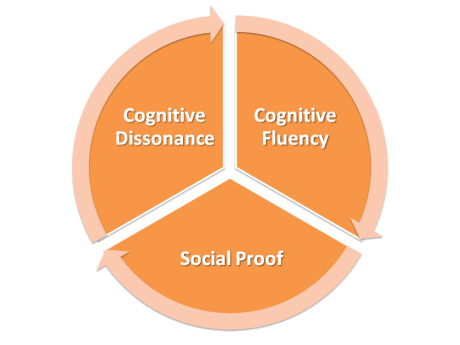
What has changed dramatically in the past few years are tactics employed in marketing, but the guiding principles have remained the same. To succeed in attracting buyers, there are three basic psychological concepts that marketers must leverage when developing messaging: cognitive fluency, social proof, and cognitive dissonance (the sequence changes to social proof, cognitive fluency, and cognitive dissonance if you are trying to establish yourself for the very first time).

Cognitive fluency basically means that something can be easily understood. And if something is easy to grasp that also signals to the brain that it is true—Occam’s Razor, or the that-makes-sense-to-me effect. This has profound implications on your positioning.

Let’s assume you have a product or service for which a category doesn’t presently exist. In theory you have a tremendous opportunity, because you can define and own a new category (think eBay). The unfortunate downside is that it actually takes a tremendous amount of resources—especially time and usually a lot of money—to do this missionary work successfully.

If you continuously need to explain your new category, you may be building up long-term brand equity should your business or product launch turn out successful. But in the interim, however, you are not enabling cognitive fluency, as potential buyers need to first spend countless brain cycles on making sense of your message. While they’re doing that they are not thinking about the benefits of your offering, and are thus significantly more likely to abandon the idea of engaging with you, since they are not building an emotional connection with your message.

That is because we humans naturally categorize, which helps us understand, only after which we can process further input. If I cannot very quickly categorize what you do, I simply seek other message that I can rapidly absorb and act on.

An easier approach that enables cognitive fluency is to pick an existing category, but carve out whitespace with that environment. Now, because the listener can rapidly categorize you, you can move the conversation more quickly, because you are being given license to explain how you are unique within that category. You are permitted to espouse on your unique selling proposition (USP, the thing that sets you apart). This is a fun conversation for both sides to have as all involved in this exchange of ideas and knowledge can contribute to the conversation, either by asking intelligent questions, or hopefully providing meaningful information.

The litmus test for cognitive fluency is not whether your product is easily explained, but if it’s easily understood.

Social proof has been in the marketing news a lot lately. That’s because it works. Social proof is the very basic concept that if you yourself are not familiar with something, but others you trust are and are happy with that product, you are significantly more likely to try the product. “If it’s good enough for Person X, it’s good enough for me.” Examples include movie recommendations, VC investment decisions (why you need to have a strong board), automobile purchases, etc. The list is literally endless.

Beware, however, that social proof can be used surreptitiously to move buyers to a purchase without that “proof” itself being true or validatable. Having only “4 more of [something] in stock” may or may not be true, but having only “two tickets left at this price” is almost always an outright lie. This feeling that an offer may cease to exist because others are seemingly acting upon it triggers a natural acquisition instinct; scarcity a market can make. While the proof itself isn’t really social—as it involves strangers, it is more societal or communal—some marketers hope to create then exploit a buyer’s emotional reaction.

Marketers are well advised to be truthful in their social proof messaging, lest lies and deceit reveal themselves at a later time to cause brand equity erosion. Don’t trade-short term gains for long-term profits (read: customer loyalty).

Fred Wilson (AVC.com) summarized the importance of social proof in his seminal Marketing blog post where he wrote that “marketing is for companies who have sucky products.” The point is that aside from needing to make sure that you actually have a good product, equally important is that your first customers (“Innovators”) are ecstatic about it. This will (a) make them share their experience with others and provide you with the most powerful marketing of all, word of mouth (e.g., social proof), and (b) provide you with truthful customer testimonial (e.g., social proof) on which others can safely base their purchasing decisions.

Crossing the Chasm” (HarperBusiness, 1990) relies entirely on social proof. The next group of buyers only ever buys because the previous group—on whose recommendation the current buying decision hinges—has successfully adopted the product.

Social proof = trust = reduced risk.

Cognitive dissonance refers to holding competing or incongruent thoughts in the brain at the same time. Apparently that’s a feeling—almost an emotion—which people don’t like. But it also makes the brain think—literally. Most of the time the brain is at rest, helping the body perform autonomic functions. Every once in a while the brain actually signals to us that we should be paying attention to something; that’s the thinking part.

Cognitive dissonance causes thinking because conflicting beliefs must be resolved. The cognitive dissonance theory states that we change our attitude toward one of the conflicting beliefs to once more achieve harmony. However, in marketing the approach is that both conflicting beliefs are indeed true, and what must change is our attitude toward the outcome, which we previously thought untrue or impossible. For example, you can perspire profusely but still smell great, or you can drink coffee that whitens your teeth.

And that’s a powerful ally in messaging. Your USP must evoke “positive” cognitive dissonance by promoting a benefit that was previously considered a trade-off. But this USP must also be true! If your USP does not deliver on its promise, word will get around quickly and your competitors will crush you.

A USP that creates positive cognitive dissonance and actually delivers on its promise unhinges the competition in such a way that it cannot easily combat your claims.

Positive cognitive dissonance = yes, you can have your cake and eat it, too.

Marketing Psychology

All three concepts highlight why a strategic approach to marketing is so critical. Without a good understanding of the buyer’s perception of your product you will never be able to categorize yourself in a meaningful manner that enables cognitive fluency. Without happy customers you will not experience social proof. And without a USP that enables positive cognitive dissonance you will not set yourself apart from your competition.

Steve Patrizi's New Marketing & Sales Funnel

Copyright Steve Patrizi

Don’t gotta say more than that (but you can read Steve Patrizi’s post here). Pairs well with The Seller’s Compass™.

The other day I received an email from Dean & Deluca with the subject line: “Oops!”

Oops what? I hadn’t order anything. Was this spam? Did D&D get hacked? Did I leave my credit card somewhere? Am I receiving a gift (cheese please!).

WTO!!! (What the Oops!)

Turns out, D&D had apparently sent me a marketing email earlier with a link to an item that was out of stock—or so they claim… To patch things up I was offered a coupon for 10% off my entire next purchase. Talk about pro-active customer care. Or was it?

I am suspicious; I smell the next evolution in relationship marketing. It’s dead simple to purposely generate an “adverse” event like an out-of-stock SKU, and then leverage that occasion into a “positive” situation for the vendor.

D&D’s email doesn’t say which product was out of stock, they only apologize for something being out of stock. Then they offer me a discount on hugely overpriced merchandise (some of which I’d really like to own). Any marketer could purposely create a minor annoyance, apologize profusely to endear themselves to me, then offer me a discount not on the item out of stock, but on my entire next order to entice me to spend A LOT more money on them than I had previously planned to. Thus emptying my wallet and driving their bottom line.

One of two simple scenarios is at play here: (1) D&D accidentally screwed up and wants to make things right by diffusing my negative emotions; or (2) D&D purposely screwed up and wants to make things “right” by exploiting my positive emotions brought on by their corrective effort.

Do I honestly believe D&D purposely created this situation? I can’t claim nor prove that they did. But their vague message about something being out of stock made me realize how easy it is to manipulate consumers’ emotions into larger than planned purchases.

Lesson? Beware of your own and marketers’ intentions.

  1. Numbered lists
  2. Lists about lists
  3. Meaningless lists
  4. Pointless lists
  5. Copied lists