Archives for category: Marketing

The best value proposition is to solve a complex problem simply.

The issue is that this doesn’t create any real barriers to entry for competitors since they could easily copy the solution (can you afford a full-fledged patent dispute not knowing if victory will be assured?).

Complex solutions are easy to sell…because they are complex. The complexity implies value, and people are willing to pay a lot for that—they’re not willing to pay much for simple solutions [that deliver the same value]. Paying for the process seems much more important than paying for the result.

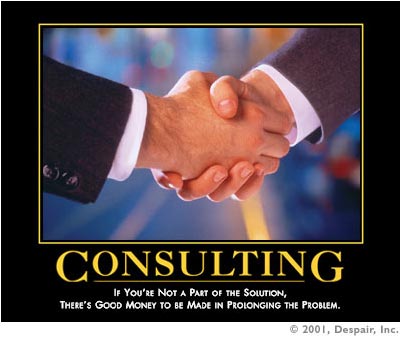
We all know the adage about consultants: if you can’t be part of the solution, be part of the problem and continue to get paid.

Imagine then a consultancy that doesn’t sell fish, but instead teaches its customers how to fish.

Kepner-Tregoe (KT) has a product called “Problem Solving & Decision Making” (PSDM) that teaches companies how to problem-solve. Such a shame then that KT’s best PSDM marketing asset—a customer video testimonial—is buried deep within the site.

You’ll never find the video—the site is a bit of a marketing (UI/UX) disaster. So here are two links to the video. Enjoy.

It’s a very powerful message, and a very simple (but not simplistic) solution. I wonder how well it is selling. And I wonder if they get repeat business from turning customers into thinkers and independent problem-solvers.

A brand is a promise, a social contract, an implied guarantee, a reducer of risk. However, all that presupposes that a brand is centered on a positive experience (or the promise of one).

Psychologically brands are emotional reactions toward these expectations, be they repeat or first-time. Emotional reactions are formed over the short- or long-term depending on the circumstances, but are generally long-lasting in either case. However, they are not always positive.

Therefore, I believe that because both positive and negative emotions  toward expectations exist, positive and negative brands must exist as well. Having a brand does not mean you have succeeded, it means you’ve succeeded or failed rather well—nothing in-between.

Riffing off the idea of the net promoter/detractor continuum, I think of brands the following way:
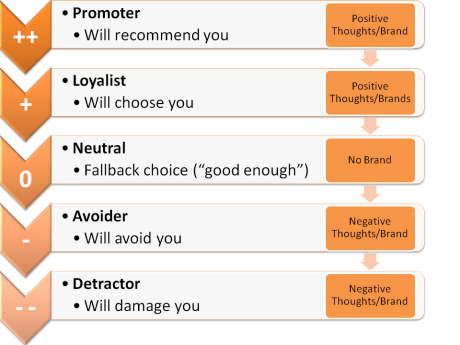
Think of laundry detergent. You have thirty choices, but will typically prefer one over all others, and if that one is not available you may decide to go with a fallback choice as a last resort. And there may be one choice that you will always avoid, even if it’s the last bottle left on the shelf. The rest of the choices are neutral, meaning they are not brands, as you have no feelings about them. Brand, by definition, is therefore a personal experience.

The brand, and your emotional attitude toward it, is a mix of personal and external influences, typically not within the control of the brand owner—actually, you are the brand owner; the originator is the brand steward. How you react toward a brand decides whether it’s a positive or negative brand. Past experience matters a lot, but so does testimony from your peer group (family, friends, colleagues), and trusted third-party advisor (e.g., Consumer Reports) when approaching a first-time experience.

Since brand loyalty is more easily lost than won, brand stewards have to have a deep understanding of the motivations and emotions for being a choice, lest they wish to run risk of sitting on a negative brand at any point in time.

If I have a negative reaction at the thought of you or your product (U.S. Airways, Cox, Sucralose), you have/are a negative brand with me.

Where the net promoter/detractor concept comes back into play is the ratio of positive vs. negative emotions toward you/your brand. It’s much more important to avoid creating negative experiences than it is creating positive ones. You can always work on improving yourself; it is nearly impossible to erase negative experiences and emotions, however.

Note that I don’t have to share my negative feelings about you with others—to damage you—to have a very negative impact on your business. Instead, many of us have the memory of an elephant and will abide by our positive and negative experiences for a long time. And while the customer definitely is not always right, be aware that you are continuously building a positive-negative brand ratio.

J.C. Penney has in a very short span of time managed to become a negative brand for many.
My wife and I joined in a family trip to Hawaii to celebrate her parents’ 50th wedding anniversary. Each person booked his/her own flight and accommodations, but as it turned out eight out of ten of us were on the same non-stop flight out of Phoenix.

Yes, I did fly US Airways, even though they punish me for being a good customer (previous post). It’s called monopoly power.

My wife is lucky in that as a phenomenal freelance editor she has so many adoring clients that she’s always drowning in work (a real problem, actually…). She’s been pulling 3+ all-nighters per week for the past month just so that she can actually go on this trip. She hasn’t flown since 9/11—we’ve literally been driving cross-country to get everywhere.

We all bought tickets in fourth class (First: First Class; Second: Business; Third: Economy with extra leg room; Fourth: Economy with “normal” leg room). I fly fourth class 99% of the time, but have occasionally stumbled into better seating. However, to give my wife some respite and something to look forward to since she’s avoided flying, I decided to upgrade us to first class. Anyone who has flown internationally knows that first class on a US airline is barely equivalent to business class on other airlines, but it is remarkably better than fourth class (that still doesn’t make it good, however).

We are seated in the third row. The flight attendant comes around to take our meal order: “I’m sorry, but we’re all out of choices, we only have tortellini left but we have a lot it.” My jaw only hit the floor at her follow up: “I hope that’s okay with you (?).”

It’s the first time my wife is flying first class, and she’s not having a first-class experience. U.S. Airways has quickly become a negative brand with her. And I’m still struggling with what my answer to the above question should have been.

[Really, I’d prefer sticking to writing about good branding and marketing strategies, but Salesforce.com makes it too easy to keep this thread going.]

The saga continues. First, Salesforce.com cannot figure out what my needs and expectations are, even though I’ve expressed them many times before (previous post). Then they cannot follow up properly on their own promises (other previous post; FYI, once I finally chatted with the Radian6 rep I had a phenomenal experience, and I made sure her boss knew).

As you recall, I renewed our Jigsaw (Data.com) subscription. However, you don’t know that once the renewal had kicked in our points were set to zero, meaning we could not access and download data anymore. NOT what should be happening after renewal.

My first step was to reach out to customer service. I filled out the service request form at Jigsaw’s website, and immediately received an auto-response email with my ticket number.

A day passed. Nothing happened.

I responded to the email, copying my account rep and my renewal manager.

A day passed. Nothing happened.

I forwarded the service request auto-response email to customer service at Data.com.

A day passed. Nothing happened.

I called and learned that (a) they are really backed up, and (b) my ticket is not in the system—so it doesn’t really matter how backed up they are because they’ll never get to my issue (?).

I also finally learned through osmosis that the corporate-, training-, and customer service cultures at Salesforce.com are to not give a crap. The person I spoke with did eventually get my issue resolved, but that is beside the point (taking responsibility the first time around is the point).

The lesson for marketers? Customer life-cycle experience is your brand. Else, your best hope for survival is to have a permanent monopoly, this way you have license to deliver crappy customer service round-the-clock.

There are several types of learners: visual, auditory, reading, and kinesthetic. White papers appeal to reading learners.

But what is a white paper, and what is its purpose? First and foremost it is an educational tool. The author analyzes and synthesizes data and information objectively, and then draws a mind-blowing conclusion that is hard to refute. In theory; but really not that infrequently.

Once the white paper exists it can be given away freely to establish or cement thought leadership. Beyond that, reader data can be collected and leveraged for lead generation. A typical example is to ask for an exchange of data: I give you the white paper for “free,” if you give me your contact information. People who sign up for white papers know that they will get marketed to, but that is a fair exchange if the white paper actually delivers value.

So, white papers do a good job of educating and generating goodwill (make sure your white paper delivers value, or all you will have managed to do is generate a lot of ill will), help with lead generation and even search engine ranking, but they appeal to only a subset of your audience because they are [relatively] difficult to consume.

A new trend in education is blended learning, a combination of self-paced, face-to-face, and online collaborative learning. More importantly, however, blended learning isn’t about the delivery platforms, it’s about stimulating the brain in multiple ways on the same subject matter via traditional and e-learning methods, and in that process addressing all types of learners. A more holistic approach.

Webinars combine all three aspects. (1) They are online by default and can be consumed from anywhere. They are collaborative because they often include a meaningful Q&A session at the end, during which additional teachings and comprehension are delivered. (2) They aren’t truly face-to-face, but since they are often live and provide the ability to ask questions and get answers, they make you feel like you are part of a live information exchange. And (3) they can be self-paced because you can re-watch them, and frequently the host will make the presentation materials available for download and later review.

eTrigue is a provider of marketing automation and sales acceleration software (in the cloud), and an excellent example of how to educate using a blended approach. Its “Friday Coffee with eTrigue” webinar series is an educational series for novice and expert marketers alike to educate us on issues and solutions relevant to our profession.

Of critical importance is that eTrigue doesn’t use the webinar to promote itself, but that the company features expert industry thought leaders to present on relevant topics. About half the time eTrigue’s platform could be part of the solution, but that is not the reason to for hosting the webinar. Presenters have included Barry Castle (Skype), and Christine Crandell, the best marketing philosopher of recent times (personal blog; Forbes blog).

Once the event is over the company makes the recorded webinar and presentation available to anyone for later viewing and download, not just pre-registered attendees.

eTrigue still also makes white papers available on its website—white papers do provide value. But webinars can actually engage the audience. The fact that eTrigue recognizes the importance of nurturing and nourishing the community is very telling of modern marketing memes.

Marketers need to participate in the community they are trying to sell in to. eTrigue has learned how to lead the conversation.

For those of you keeping score at home regarding my iPad purchasing saga (see post about Apple), based on Apple’s advice I switched from Apple’s online store to Best Buy. So that you don’t have to read the whole previous post, I ordered too many iPads from Apple and was subsequently banned from buying more.

Today I received a cancellation email from Best Buy because they were “…unable to verify my information.” So I called to verify my information.

First I was asked for my phone number so that they could look up my name. My question about why they didn’t just ask for my name went unanswered. After finally locating my order—once I gave them the order number (why didn’t they just ask for that in the first place?)—I learned that once more I’ve ordered too many iPads, and this order will not get filled.

I’ve seen this movie before.

No one in customer service was able to tell me what the order limit is, but I was told with absolute certainty that not a single person at Best Buy would be able to override it.

Since I’m decent at math I figured out the order limit myself. This was my third order (the very first one I placed was the one that Apple had canceled on me about ten days ago), and therefore the purchase limit has to be 2.

That could make gift-giving very tricky for some people.

It certainly puts a damper on my ability to stimulate the economy. Carole Inman (marketer extraordinaire) put it this way to me:

I think we have identified part of the reason the US economy is lagging – self-inflicted injury! 😦

It also goes against every marketer’s mantra of not over-promising and under-delivering, which is beginning to affect my efforts. Since I have a supply chain problem, it’s time to either seek alternate sources (not working) or substitutes. I feel a Five Forces blog post coming on . . .

Definitely time to reach out to Amazon.com to see how they feel about gifting the Kindle Fire.

Change management must include all stakeholders, and customers are stakeholders, too.

J.C. Penney Is the New Sears: Ron Johnson Has Done “Incalculable Damage,” Davidowitz Says is a fantastic article (and video) about JC Penney’s massive misstep in going to an everyday-low-prices model in this economy.

Anyone with a clue could have forecast this, and many did (my wife and I chortled at the original announcement, predicting failure on the spot). Apparently, Ron Johnson, JC Penney’s CEO, needs to get out more, or did the entire JC Penney board miss all the popular extreme-couponing TV shows?

Howard Davidowitz correctly asserts that limited in-store testing would have been advisable over betting the whole company on a hunch.

Better yet, leveraging JC Penney’s customer insights team should have been the first step before performing any in-store testing. These brand protectors and profit maximizers know how to perform a conjoint analysis survey and interpret its results.

A conjoint analysis is often misinterpreted or pigeon-holed as helping a company figure out its pricing, which is why it might not seem the right tool for JC Penney (since the company was very clear about how it wants to price). Instead, a conjoint analysis survey helps a company figure out what trade-offs a customer is willing to make–meaning, without being asked directly, the customer will inform the company of what is truly important to him/her. Typically clusters of choices will emerge, and a company can then build its go-to-market strategy from there.

In JC Penney’s case the conjoint analysis survey could have been leveraged to learn what’s important to customers today. Yes, customers always want the most for the least. Luckily, a well-designed conjoint analysis survey lets you actually sidestep that issue, and instead learn about customer price elasticity, shopping preferences, and motivators.

JC Penney could have leveraged many channels, including focus groups, but more importantly social media and public communities to get real meaningful feedback on its proposed pricing change.

Thus, even prior to any real-world testing, meaningful insights could have been collected. Then a limited roll-out should have been used to complete the testing phase.

A conjoint analysis is not a change management tool, but it can be used to measure the impact of a proposed change. As Ron Johnson said, “…the customer ignored us 99% of the time.” With proper foresight he could have made sure not to have pushed that to 100%.

Luckily, as CEO he can blame others:

Our marketing isn’t doing the work . . . We’ve got to get our pricing across. Coupons were a drug, they really drove traffic. [Customers] need to understand the value we’re offering.

Sheesh!

This blog is not about customer service, it is about marketing and branding. Marketing and innovation are the only two functions of a company (thank you, Peter Drucker, written in 1954!). Successful execution of both creates a brand.

Marketing is the process of getting your product into the market: that includes sales, promotions, advertising, distribution, etc. But it doesn’t stop there, because you have to close the loop—you need to nurture your customers and provide a continuously satisfying relationship, in both B2B and B2C. You need great customer service because the customer owns your brand!

Back to Salesforce (see previous post).

It was time to renew our Jigsaw subscription (Data.com, owned by Salesforce.com), so I sat through a demo of new features (there weren’t any as yet). The first strange thing—but not the point of this post—was my Jigsaw account manager was giving the demo, but a renewal manager was handling the renewal. Why do I need a Salesforce.com account rep, a Jigsaw rep, a renewal rep, and soon a Radian6 rep (more on that below), when they’re all working for the same company? It makes for a crappy customer experience, and Salesforce.com clearly doesn’t grasp the “Merger” part of M&A.

At the end of the demo I was asked if there’s anything else I would like to know or would like help with. As a matter of fact there was. I would very much like to see how Radian6 integrates into Salesforce; I would like to see a demo.

The renewal manager assigned herself the “action item” to alert the right person and get that set up for me. The next day I received the following email (the Radian6 rep was cc’ed):

Hi Marc,

I wanted to follow up form our call yesterday and put you in touch with your Radian6 Account Executive, [Name].
She will be able to answer any questions and basically take it from here.

Thanks,
[Name]

Customer satisfaction opportunity missed!

The renewal rep made follow up my responsibility—something I could have initiated on my own with better results. What really happened was that expectations were set by Salesforce staff, then not acted upon.

I was told to satisfy myself.

What should have happened was the renewal rep call the Radian6 rep and hand me off as an opportunity (as an existing customer). Then the Radian6 rep should have called or emailed me with relevant information and set up a demo. Result: happy customer.

I took the bait and responded to the Radian6 rep, not bothering to wait for her to make the first move. Worse still, now 24h later, she still hasn’t responded.

Salesforce.com is well on its way to becoming a mainstay on this blog for how to fail in marketing and brand protection.

McKinsey Quarterly just published “Measuring marketing’s worth” (free subscription necessary). All of us marketers struggle with answering this—not because we cannot measure outcomes, but because we don’t have good traceability: inputs are difficult to connect to outcomes (often because of cross-channel marketing activities). Or as the saying goes: 50% of marketing dollars are wasted; we just don’t know which 50%.

In short, the article posits the following “five basic questions”:

1. What exactly influences our consumers today?
Marketers must be ready to use the findings to debunk accepted wisdom and legacy rules of thumb. In today’s fragmented media world, only by knowing how the way consumers interact with your company has evolved can you begin to make more cost-effective marketing investments that truly influence purchase decisions.

2. How well informed (really) is our marketing judgment?
Data remain only as useful as the expertise you bring to bear, and good judgment will remain a hallmark of the best marketers.

3. How are we managing financial risk in our marketing plans?
Managing risk is critical, and marketers shouldn’t be shy about putting this issue squarely on the table. With thoughtful scenario planning and cross-functional participation, such discussions can be extremely rich and rewarding.

4. How are we coping with added complexity in the marketing organization?
First, you’ll require a number of specialists. Second, you’ll need somebody who both integrates marketing efforts across channels and communications vehicles and focuses on the bottom line. Finally, you’ll need absolute clarity in processes, roles, and responsibilities not only within the marketing organization but also throughout your company (across functions and business units) and externally (with agencies and external vendors).

5. What metrics should we track given our (imperfect) options?
The volume of data available today should make it possible to find metrics and analytic opportunities that take advantage of your unique insights, are understood and trusted by your top team, provide proof of progress, and lay a foundation for more sophisticated approaches to tracking marketing ROI in the future.

Again, you really should read the whole article, rather than just the truncated excerpts above.

After that you have to read John Stauffer‘s “Social Brand Planning” article (Journal of Brand Strategy, April-June 2012, Volume 1, Number 1). John wrote the must-read (!) marketing article of the year so far: very strategic with excellent tactical guidance.

Specifically, John Stauffer explains in detail what and how brand planners need to execute:

  • Actively listen to slow and fast culture.
  • Identify their biases early on in order to break down some of their barriers to empathy that exist within brands and agencies.
  • Apply insights from social media upstream into the major arteries of brand planning.
  • Build consensus on a cross-practice measurement model designed to yield a realistic and timely assessment of marketing and communication efforts.
  • Lead an enterprise-wide planning model that acknowledges consumers do not think of a brand in discrete categories of marketing, communications, public relations, or advertising.

Run, do not walk, to your nearest library, and demand a copy of the journal. Or just buy it. Then you can answer the five questions McKinsey has thrown at you.

Lois Geller has a great blog on Forbes. Yesterday’s post, “Why A Brand Matters,” gives a simple, common-sense overview of how your business can benefit from having a brand.

Here are two other great reasons:

  • Strong consumer goods brands get to charge 25-30% more for the same thing than non-brands.
  • Brands with a vast number of net-promoters out-revenue their competitors 2:1.

That means even at the higher price you get chosen more often, and that drops directly to the bottom-line (if your costing and pricing is right)!